Sunday, March 10, 2013

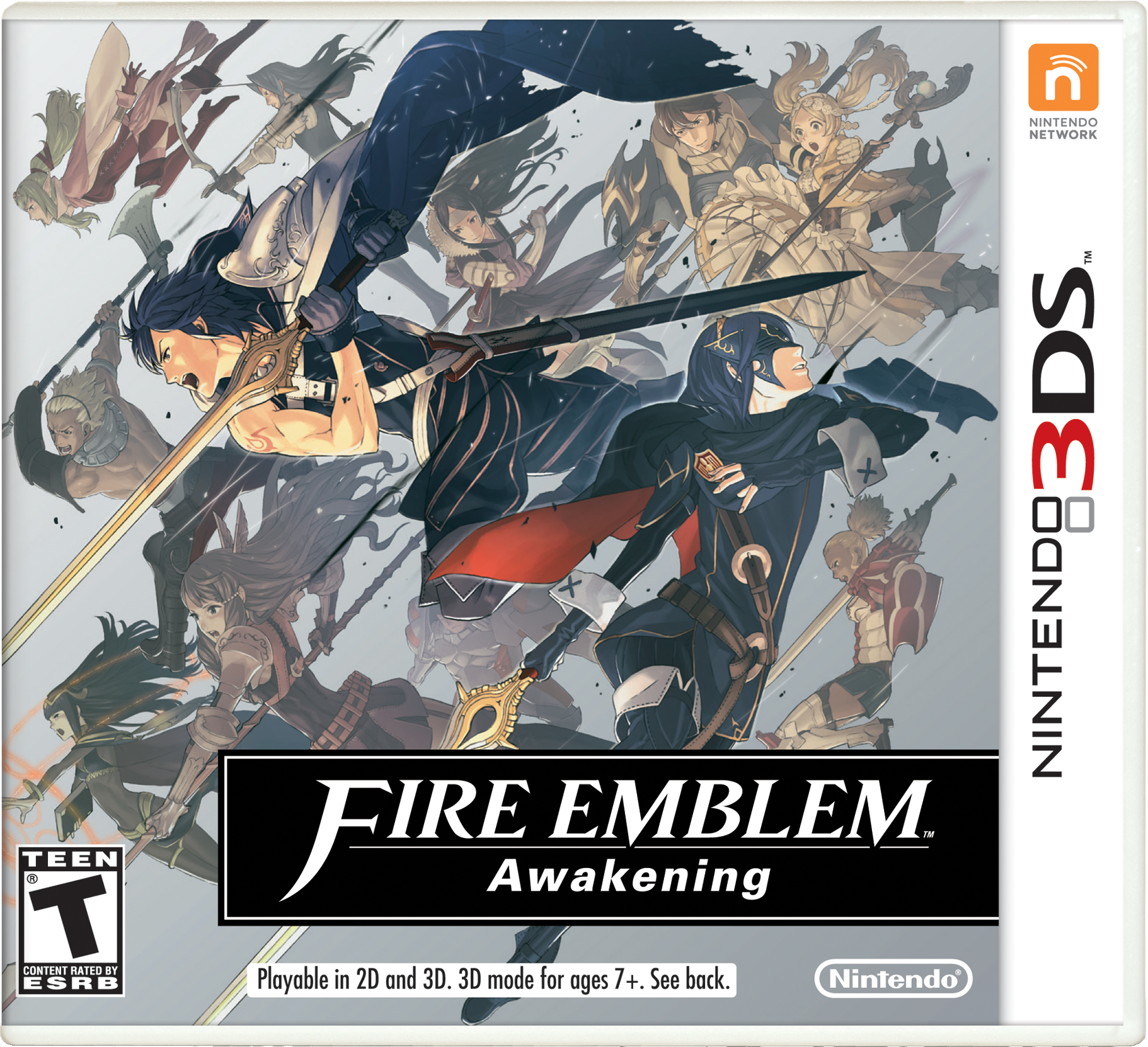
Fire Emblem: Awakening - Nintendo 3DS

from: fireemblem.wikia.com
Time for a video game post. This is the most recent installment in the series, and it got quite an upgrade. Let's just assume you know all about the series, or if not, you'll only need to put in a small amount of effort to learn if it's something you'd consider buying.

The positives:

Obviously, the graphics are better. The 3DS is practically as powerful as the Wii, so naturally everything will look great. I'm not big on the 3D personally, but if you are, Fire Emblem doesn't disappoint. Other than that, the profiles are drawn wonderfully, done in the same style as Path of Radiance and Radiant Dawn. Maps look even better, and battles are worth watching again and again (though they do get tedious when simply leveling up).

The world map is massive! With extra sidequests, called paralogues, and the already 25 chapter main quest, there had to be many different areas. Add to it the extra places from DLC, and we've probably got the biggest Fire Emblem world map yet.
from: fireemblemwikia.com
The ability to reclass units. Level 20 no longer means you are done. With an item you can change a character's class once they reach level 10 for a base class, and level 1 for an upgraded class. Two things to consider, though. The unit will only have a certain amount of classes available (minus MyUnit's children). Also, an upgraded unit level 1 through 9 can only reclass to a base class. However, once they reach level 10, they can reclass to an upgraded class. Take Frederick for instance, a great knight. If reclassed during levels 1 through 9, he can change to a cavalier, wyvern rider, or knight. If reclassed at level 10 or higher, he can be a general, a paladin, a level 1 great knight, a gryffon rider, a wyvern lord, or any of the base classes again. This process allows for the continuation of stat growth, but most importantly to gain extra skills.

Units can equip up to five different skills. Enough said.

Marriage! Ok, that's not so awesome in itself, personally, but the units then have children that return through a time portal (won't say anything else). Those children then inherit certain skills from their parents, which can make for some awesome combinations.

DLC. Reasonably priced, and allows for not only rare items, but an easy way to get gold and experience.

The addition of MyUnit. Customization is a bit limited, but when compared to other Fire Emblem games, it's great.

The ability to choose between casual and normal settings, on top of the difficulty. Casual allows units to be defeated, yet not disappear after the level is finished. Normal is what we are used to from Fire Emblem; if a character dies, he/she is gone for good. In my case, I restart. Good for first-time players and those who just want to leisurely play.

The addition of being able to pair units. Say you have a weaker unit you'd like to level up, but he/she is too weak to really do anything. Pair up a high level knight, let's say, and that weak unit gets a boost in stats for as long as he/she is paired. Also helps with support levels, which in some cases leads to marriage and children.

The undecided:

DLC. Most make sense, but the two I'm undecided on are the level you get 1000, 3000, or 7000 gold for defeating enemies and the level where you fight the yellow undead creatures that give lots of experience when  defeated. Personally, I like it, especially when playing on harder difficulties as I can afford the better weapons and power up my units. But is that really competitive? Should I really be able to go into the main quests with all my units carrying a silver and killer weapon? Oh, and have reclassed a few times after reaching level 15 of an upgraded class because experience is easy to get? I guess you can always choose not to play these levels.

The negatives:

The difficulty settings. I have yet to play lunatic, but I felt that there was too big of a difference between normal and hard. 'Normal' should be 'Easy', and a more accurate 'Normal' should be added.

I didn't find the story super engaging. There was finally a twist at the end, which made me happy and understand more of the beginning, but I thought it took too long to get to that point. Granted, you don't play Fire Emblem for the plot, I know. I felt that this game tried to have one, though, and it didn't do a very good job. With support conversations being an even bigger part of the game, how many side stories could be going on? There are some good aspects, but my writer side wasn't very intrigued.

I don't know when would be the appropriate time to push boundaries for game boy games, but since Awakening added marriage, I thought I'd bring it up. Men/boys have to marry women/girls. It makes sense when the whole purpose of getting married is to then recruit their children, but if we're already going to do the whole time warp thing, maybe a gay couple could adopt a child and that child would come back in time. Just saying.

Fire Emblem: Awakening was definitely worth the buy for me. But if you're anything like me, be prepared to spend more than $40 (DLC can be bought in sets of three levels each for $6. As of this post, there have been three sets rolled out).

Tuf Voyaging - a collection of stories

from: isfdb.org
George R.R. Martin is widely popular for his Song of Ice and Fire series, but I'm not sure if many people know of his earlier writing. Before Ned and Robert were taking back the lands of Westeros, Martin was writing about strange religious practices, controlling dead men, and thirty kilometer long spaceships. Yes, Martin wrote science fiction, and as his writing of fantasy portrays, he wrote it well. Most of these early works are novella length, though some would probably be considered short stories. If you want a story to start with, I would suggest A Song for Lya. I've read it three times now, and it's easily my favorite. But in this post I look at the collection of stories that center around the very tall, very pale and hairless character of Haviland Tuf.


You can find the stories separately, but they are all together in a book entitled Tuf Voyaging. Check it out or buy it. You won't be disappointed. As usual, I'll lay out my favorite aspects of this book of novellas.

Martin never gives us a lengthy description of Tuf, choosing instead to give us tidbits throughout, or a short paragraph here and there. We get a very clear picture of him from how he acts, speaks, interacts with others (especially his cats), and how others interact with him. This is how character description should be done.

As an ecological engineer (read it to understand more), Tuf deals with some seemingly petty issues. However, they turn out to be rife with ethical dilemma and moral conundrums. Rightly so, too, when you stop to think about some of them.

The stories can be read alone, or all together. As a single book, reading from cover to cover, I think I enjoyed it more. That's not to say that had I read a single story I wouldn't have enjoyed it. I read A Beast for Norn a year or two ago and thought it was great. This is how a collection of stories with the same character should work.

Once you read a lot of his science fiction, you realize everything takes place in the same universe. He'll reference different alien species, like the previously enslaved Hruns, that aren't pivotal to the current story, but that are also included in other of his science fiction stories. It's a cool feeling to be wrapped in a single universe but reading about completely different characters and stories.

Martin is obviously a master of description, as I touched on with his character description above. Ships come to life, even the battered old gray ones. Planets are vivid, whether they are covered in man-made technology or blasted with pestilence. The best example is the space port of S'uthlam, more often called the web. It's so expansive and so not-of-our-current-world, that Martin only vaguely describes it. But by doing so, and by the few attempts he does make to describe it, he lets the reader's imagination go crazy with this massive structure.

All positive, which I hope doesn't become a trend with me. The only negative one I can think of is that there aren't more Tuf stories. But who knows, maybe when Martin gets a bit exhausted with the next installment in A Song of Ice and Fire, he'll envision a new scenario for Tuf to solve. I sure hope so. And if you've finished A Dance with Dragons and are annoyed you'll have to wait so long for the next one to come out, pick up some of Martin's earlier writings. You won't regret the interim.